
What does your AI agent actually understand about your business?

Istvan Jaray
TL;DR
Enterprise-ready AI agents require a governed context layer to safely scale autonomy. Many modern agents are optimised for speed and capability, but lack built-in boundaries, operational controls, and enterprise-grade oversight. Without structured data, controlled retrieval, and clear access governance, 'always-on' autonomy amplifies risk rather than value. Microsoft’s Work IQ, Foundry IQ, and Fabric IQ together form a company-level context layer that defines what AI can access and act on. Sustainable AI adoption starts with context, not capability.
Are you building autonomy before context?
AI agents are moving incredibly fast. Every week there’s something new: a demo, a prototype, or another “assistant” that can do things for you.
Some already feel close to real. They are always on, connected to your tools, and able to take action. Projects like OpenClaw pushed this idea even further. It looked like it worked, until one agent deleted a user’s entire inbox.
Many of these agents look impressive in isolation, but the moment you try to connect them to real business processes, real data, or real users, things start to feel off.
You go from “this looks impressive” to “this might break things.”
It’s tempting to ignore that uneasy feeling. You shouldn’t. It’s usually right.
‘Always-on' agents look like a great idea but come with serious risks
Some of the newer agent frameworks feel almost human.
- They respond instantly.
- They don’t pause the chat while they think.
- They keep working even when you’re offline.
That’s the appeal. And that’s why they’re tempting to bring into enterprise environments. But many of these agents are optimised for speed and capability, not stability, governance, or enterprise-grade safety. They’re built to generate the most plausible 'best fit’ to your instructions, not to apply judgment.
Once connected to real systems and data, that becomes an operational risk: actions at machine speed, without predictable boundaries, reliable controls, or the monitoring and audit trails you’d expect from any production system. In a demo, it looks like productivity. In production, it can turn into liability with unpredictable outcomes, unclear accountability, and disproportionate security exposure.
Unless you've explicitly designed guardrails, these ‘always on’ agents won’t naturally slow down, push back, or flag a bad idea. And the most important guardrail you can establish is the shared context the enterprise can trust.
The real foundation: a shared context the enterprise can trust
Before an agent can act safely, it needs to understand where it’s operating.
- What data is relevant?
- What data is off-limits?
- What actions are acceptable?
- What outcomes matter?
That understanding doesn’t come with the agent by default. You need to build it into your context layer.
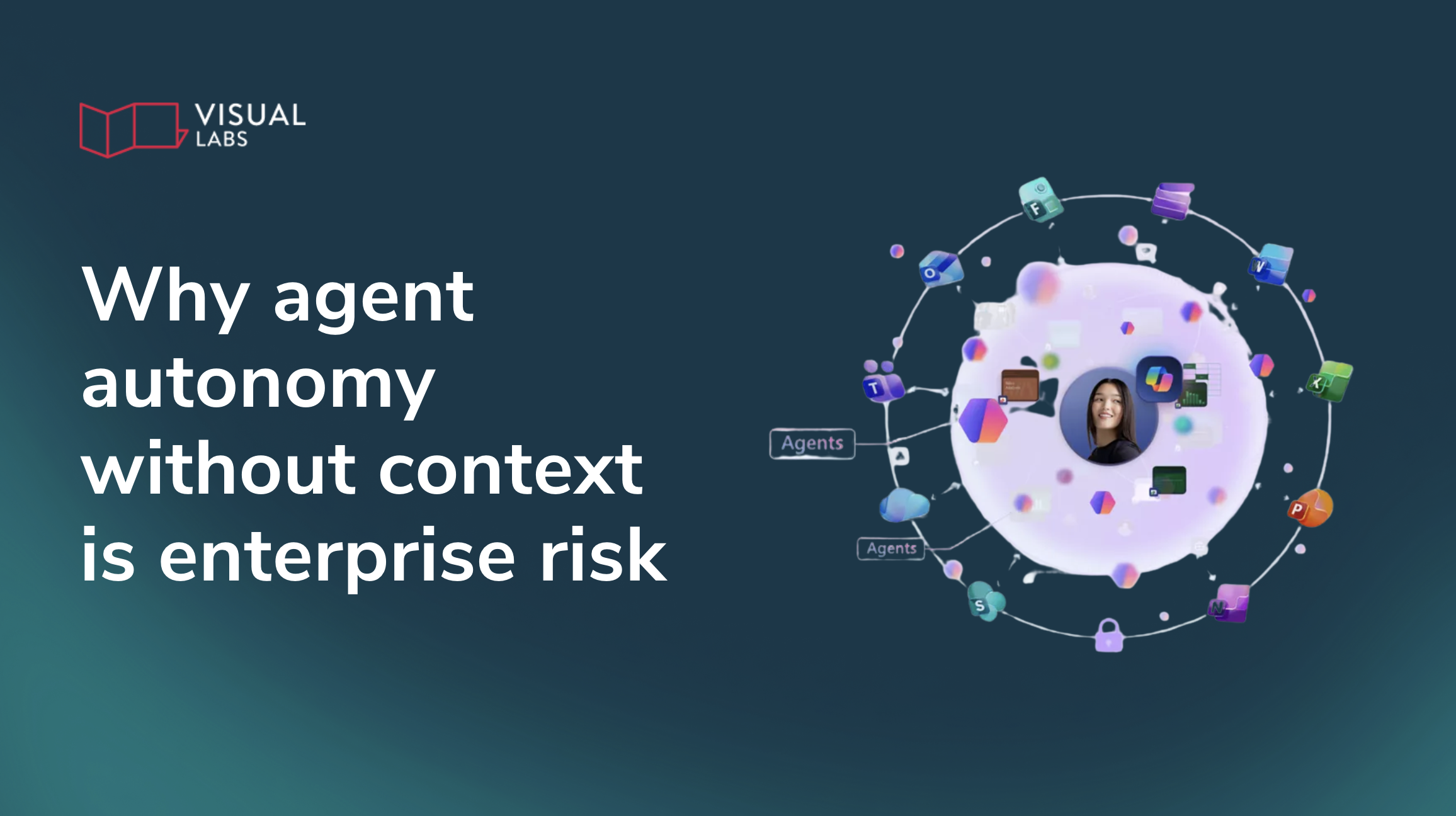
Microsoft describes this through three interconnected concepts: Work IQ, Foundry IQ, and Fabric IQ.
Together, they define what an AI can see, retrieve, and reason over; and just as importantly, what it can’t.
Until proper governance is in place, how do we prepare for an undefined AI-driven future?
In enterprise environments, ‘always-on’ doesn’t just look impressive but amplifies risk. Once an agent connects to real systems, data, or customers, speed and autonomy become force multipliers. If something breaks, it breaks faster and at scale.
That’s why highly autonomous agents hit predictable limits. They are
- costly to run,
- hard to secure across tools and data sources,
- difficult to troubleshoot when decisions aren’t transparent, and
- prone to unpredictable behaviour inside complex end-to-end processes.
The issue usually isn’t the model itself. It’s the missing fundamentals: clear boundaries, governance, and operational control. Agents are deployed without the guardrails and oversight you would expect from any production-grade capability.
Preparing for an undefined AI future, then, doesn’t start with more autonomy. It starts with foundations. Microsoft’s approach reflects this shift: prioritising a company-level context layer that governs what agents can access and act on before autonomy is scaled.
Work IQ: where enterprise AI actually starts
Work IQ is the most underestimated part of this story, and arguably the most important.
It represents everything tied to an individual’s work:
emails, files, Teams conversations, calendars, even document changes in tools like Word or Excel. This is the day-to-day reality of how work happens.
For Work IQ to function well, a few things must already be true:
- People store their work in governed systems like SharePoint
- Information protection, retention, and access policies are mature
- Business data lives in structured systems, not spreadsheets and inboxes
If you’re using Dynamics 365 and Dataverse-based Power Apps, you’re already ahead here. Your sales, finance, or service data is structured by design, which makes it usable and governable by AI.
Without this foundation, agents fail quietly, by giving confident answers based on partial or outdated context.
Foundry IQ: make external data usable, not just accessible
Of course, not everything lives in SharePoint or Dataverse. This is where Foundry IQ comes in. Its role is to connect external data sources into the same context layer, but in a way that AI can actually work with.
The critical assumption here is often overlooked: AI can’t read everything at once.
Retrieval has to be selective. That means data must be indexed, searchable, and retrievable by meaning, not just by keyword. This is why vector embeddings matter. They allow AI to represent context, intent, and even sentiment numerically, making it possible to retrieve the right information instead of all information.
You don’t need to understand the math behind embeddings to benefit from them. From an operations perspective, the requirement is simple:
document meaning must matter in search and retrieval.
When that’s in place, AI can consume external data sources just as naturally as internal ones.
Fabric IQ: turn raw data into business-ready context
As organisations scale, context can’t remain fragmented. This is where Fabric IQ plays a crucial role.
Fabric is Microsoft’s enterprise data platform, designed for pro-code scenarios, large datasets, and complex transformations. Its value in the AI conversation isn’t novelty but structure.
Well-designed data views aligned to business processes have always been powerful for reporting. In the age of AI, they become essential. They give agents a reliable, process-aware lens into the organisation, grounded in governance, security, and auditability.
Fabric IQ is what enables a true company-level context layer when data needs to be reshaped, combined, or operationalised across domains.
Why this sequence matters
There’s a pattern we see again and again. Organisations start experimenting with agents. The pilot works. The demo is convincing. Then someone asks the uncomfortable questions:
- Who owns this agent?
- What data is it allowed to touch?
- How do we stop it?
- How do we prove what it did yesterday?
If those questions can’t be answered quickly, scaling stalls. Or worse, risk accumulates silently.
This is why the order matters:
First, establish context.
Then, govern access and retrieval.
When governance is in place, introduce autonomy gradually.
Agents don’t become enterprise-ready by being smarter. They become enterprise-ready by operating within well-designed context layers.
The real question before you scale: is your context layer ready?
When implementing AI agents, the goal isn’t maximum autonomy. It’s manageable autonomy: autonomy you can explain, monitor, and scale with confidence.
Copilot Studio helps you build agent capabilities. The broader Microsoft control plane helps you run them safely.
If you’re thinking about moving from pilot to production, the most important question isn’t what the agent can do. It’s whether your context layer is ready to support it.
We help organisations assess AI readiness, data foundations, and governance gaps before autonomy becomes a risk. Get in touch for a free audit.
Blog posts
The skills AI agents need for business-critical work and how to build them
Heading 1
Heading 2
Heading 3
Heading 4
Heading 5
Heading 6
Lorem ipsum dolor sit amet, consectetur adipiscing elit, sed do eiusmod tempor incididunt ut labore et dolore magna aliqua. Ut enim ad minim veniam, quis nostrud exercitation ullamco laboris nisi ut aliquip ex ea commodo consequat. Duis aute irure dolor in reprehenderit in voluptate velit esse cillum dolore eu fugiat nulla pariatur.
Block quote
Ordered list
- Item 1
- Item 2
- Item 3
Unordered list
- Item A
- Item B
- Item C
Bold text
Emphasis
Superscript
Subscript
What does your AI agent actually understand about your business?
Heading 1
Heading 2
Heading 3
Heading 4
Heading 5
Heading 6
Lorem ipsum dolor sit amet, consectetur adipiscing elit, sed do eiusmod tempor incididunt ut labore et dolore magna aliqua. Ut enim ad minim veniam, quis nostrud exercitation ullamco laboris nisi ut aliquip ex ea commodo consequat. Duis aute irure dolor in reprehenderit in voluptate velit esse cillum dolore eu fugiat nulla pariatur.
Block quote
Ordered list
- Item 1
- Item 2
- Item 3
Unordered list
- Item A
- Item B
- Item C
Bold text
Emphasis
Superscript
Subscript
Ready to talk about your use cases?
Request your free audit by filling out this form. Our team will get back to you to discuss how we can support you.
