
How does the new Power Apps experience change app development?

Máté Tóth
TL;DR
Power Apps has introduced a new AI-native authoring experience (Vibe) where users describe a business need and the platform generates a complete application with data model, screens, logic and flows. This shifts Power Apps from low-code to intent-driven, no-barrier app creation. The direction is clear: Power Apps is becoming the AI application layer in Microsoft’s ecosystem, where natural language replaces manual app building. Organisations that modernise governance and data foundations early will benefit most.
Is low-code dead?
Earlier this year at the Power Platform Community Conference, the Business and Industry Copilot keynote introduced a phrase that has become the headline of the year:
“Low code is dead as we know it.”
It was a recognition that the foundations of app development are changing. That shift became tangible a few weeks later at Microsoft Ignite, where Microsoft announced Vibe, the new AI-native Power Apps experience, now available through vibe.powerapps.com.
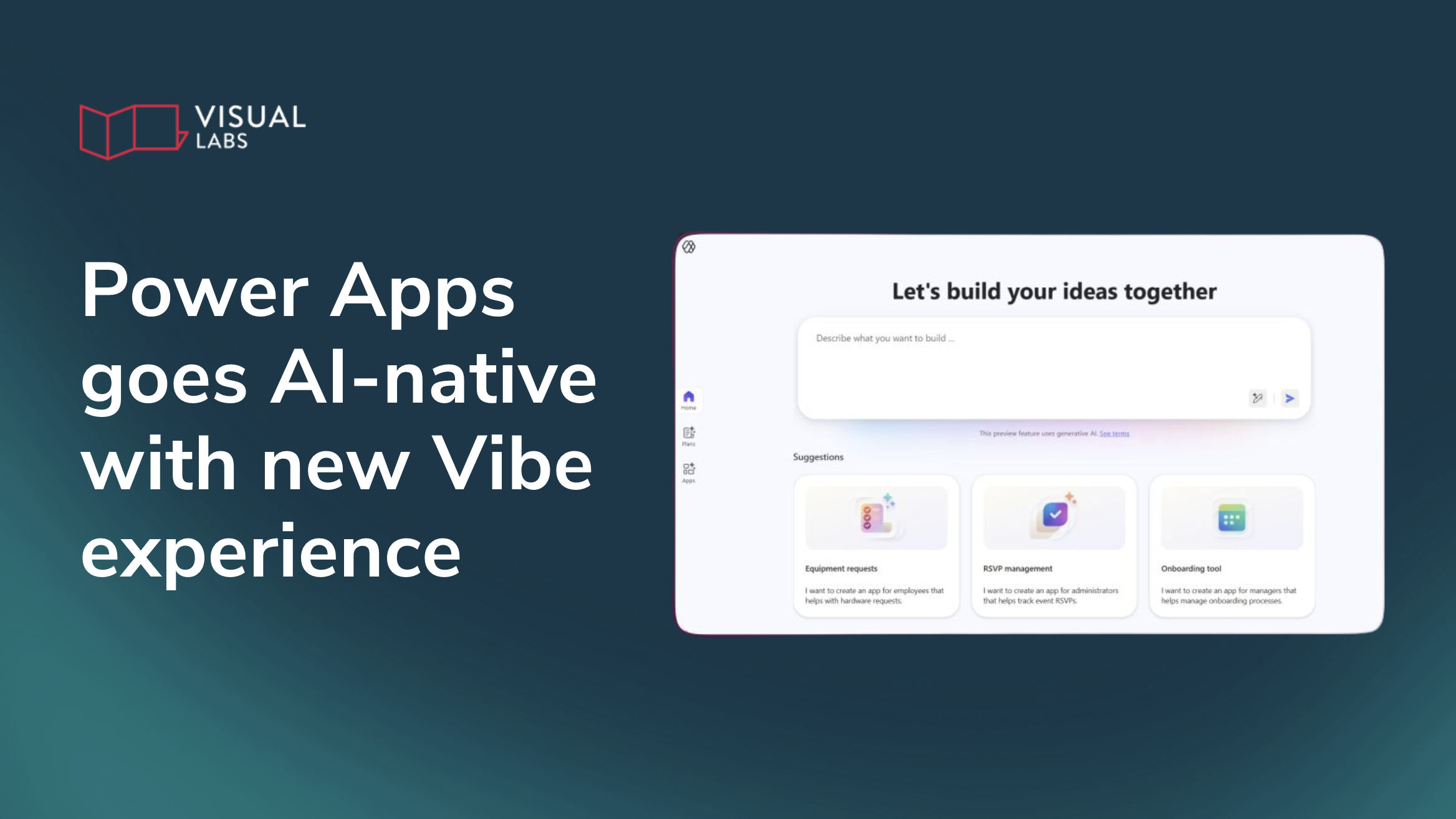
Instead of assembling screens and formulas, users now begin with intent. They describe a business problem, and Power Apps generates a working application.
This is the most significant evolution in the platform’s history, and it signals the start of a new era: AI-generated solution development.
From low-code to no-barrier
For years, Power Apps lowered the bar for business users, but the entry point was still higher than many expected. Even confident makers needed to understand components, tables, relationships, formulas and connectors. Low-code democratised development, but it didn’t eliminate complexity.
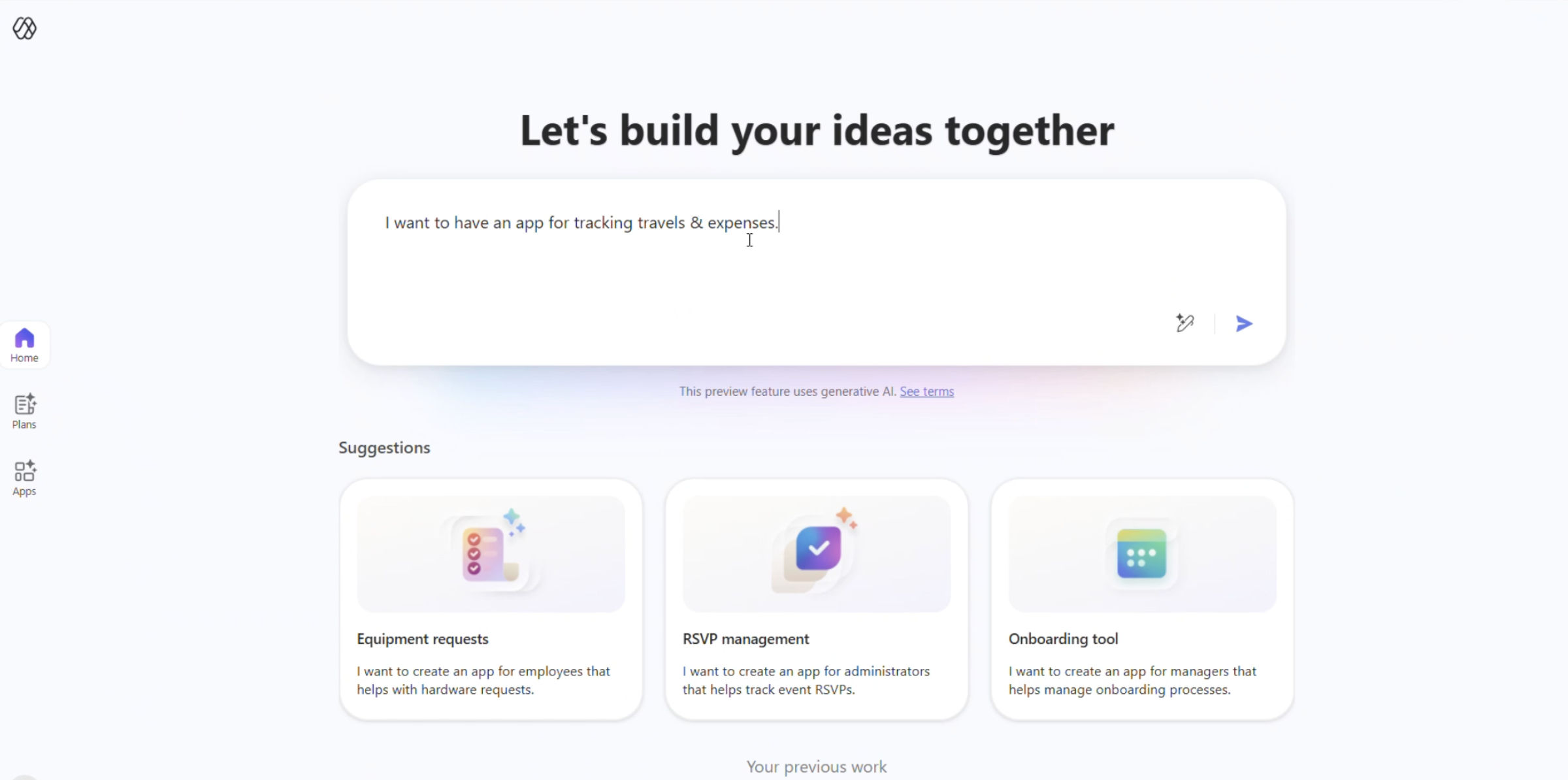
That barrier disappears in the new Power Apps experience. A user can simply type:
“I want an app to track travel and expenses.”
“I need a customer service solution.”
Within a few seconds, Power Apps produces a structured plan, a data model, screens, navigation, logic and relevant Power Automate flows. What previously required hours of design work appears almost instantly.
One message from Ignite was especially clear: the barrier to building business applications is disappearing. In the new experience, users no longer need technical skills to produce a functional app; describing the requirement is enough.
This isn’t simply an evolution of low-code tools. It marks the shift to AI generating enterprise-ready applications on demand.
A platform that codes for you
The new experience is not simply a more intelligent canvas. In Vibe Power Apps, the system generates React and TypeScript–based code structures behind the scenes. When a user asks to adjust alignment, change the theme, or add a new view, the platform updates the underlying structure and validates the changes automatically.
This makes Plan Designer more than a scoping tool. It provides a shared plan that guides how different Power Platform solutions are created. As requirements change, the plan can be updated and reused, even when apps, automations, or agents are built through different experiences.
Professional developers still play a key role, but their work shifts to higher-value layers. Instead of starting from scratch, they build on AI-generated foundations, refining implementations, integrating systems, and ensuring quality, security, architecture, and long-term sustainability.
Note: As with any evolving platform capability, the underlying implementation details may continue to change as the experience matures.

What this means for your organisation
1. Unmatched speed
Teams can now generate functional prototypes during the same meeting where ideas are discussed. This reduces the distance between identifying a need and testing a solution. Digitalisation accelerates because the early-stage friction is removed.
2. A new role for IT
As creation becomes easier, oversight becomes more important. IT transitions from being the primary builder to the orchestrator of the platform: setting standards, maintaining the data estate, defining environment strategy, enforcing DLP policies and ensuring the organisation doesn’t accumulate fragmented models or unmanaged apps.
The challenge is not that too many people can build. It’s making sure they build in a governed, consistent and secure way.
3. Data quality becomes make-or-break
AI can generate an app, but it cannot correct underlying structural issues. If organisations have duplicated tables, weak ownership or mismatched schemas, AI will amplify that complexity.
Strong data foundations, particularly the relationship between Dataverse, Fabric and line-of-business systems, become essential.
4. Higher business value
When ideas turn into runnable apps within minutes, organisations can test, iterate and validate far more frequently. This expands the capacity for innovation without expanding headcount.

Important limitations of the preview
The experience is powerful, but still early-stage. It’s currently only available in North America, so you need to set up a US developer environment if you want to experiment with it. (as of 17th December)
You should also keep in mind that:
- Apps made in the new interface cannot be edited in classic Power Apps.
- Exporting and redeploying via CLI creates a separate app rather than updating the original.
- Only one app per plan is supported today.
- Canvas and model-driven apps cannot be opened or edited in the new experience.
- Existing Dataverse tables aren’t automatically suggested, and schema editing via chat is not yet available.
- Direct code editing is intentionally restricted.
These limitations are not drawbacks; they are indicators that Microsoft is building a new category — an AI-first app development environment — that will grow alongside the traditional maker experiences.
AI as the application layer
Recent Microsoft announcements point to a broader shift across the ecosystem. Copilot is becoming the primary interface for work. Natural language is becoming the universal input. Business processes, data and applications are increasingly orchestrated behind conversational interactions.
In this future, Power Apps becomes not just a place to build apps, but the AI-native application layer that connects humans, processes and data.
Organisations that adapt early will move faster, reduce bottlenecks and empower their teams, but only if they also modernise their governance, data strategy and architectural foundations.
A turning point for the platform and for your organisation
The new Power Apps experience represents a structural shift in how digital solutions are created. The traditional act of building — dragging controls, writing formulas, configuring screens — is giving way to a world where ideas become apps instantly. Developers gain time to focus on high-value engineering. Business users gain the confidence to create. IT gains the responsibility to shape the ecosystem that makes it all run safely.
Low-code is not disappearing. But the era of manual low-code development is fading.
Intent is becoming the new development language.
Want to move from AI curiosity to real, measurable impact? Get in touch for an AI readiness workshop.
Blog posts

How to structure your context layer Fabric IQ and Foundry IQ
Heading 1
Heading 2
Heading 3
Heading 4
Heading 5
Heading 6
Lorem ipsum dolor sit amet, consectetur adipiscing elit, sed do eiusmod tempor incididunt ut labore et dolore magna aliqua. Ut enim ad minim veniam, quis nostrud exercitation ullamco laboris nisi ut aliquip ex ea commodo consequat. Duis aute irure dolor in reprehenderit in voluptate velit esse cillum dolore eu fugiat nulla pariatur.
Block quote
Ordered list
- Item 1
- Item 2
- Item 3
Unordered list
- Item A
- Item B
- Item C
Bold text
Emphasis
Superscript
Subscript
How to build custom AI agents with Copilot Studio
Heading 1
Heading 2
Heading 3
Heading 4
Heading 5
Heading 6
Lorem ipsum dolor sit amet, consectetur adipiscing elit, sed do eiusmod tempor incididunt ut labore et dolore magna aliqua. Ut enim ad minim veniam, quis nostrud exercitation ullamco laboris nisi ut aliquip ex ea commodo consequat. Duis aute irure dolor in reprehenderit in voluptate velit esse cillum dolore eu fugiat nulla pariatur.
Block quote
Ordered list
- Item 1
- Item 2
- Item 3
Unordered list
- Item A
- Item B
- Item C
Bold text
Emphasis
Superscript
Subscript
Ready to talk about your use cases?
Request your free audit by filling out this form. Our team will get back to you to discuss how we can support you.
